Applications in Biopharma,Food..
- Read More
The amino acids
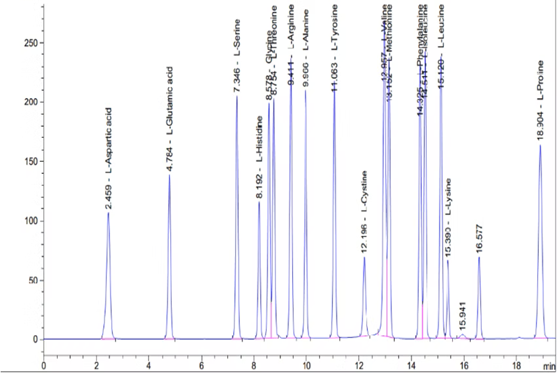
were identified and quantified by
comparing the retention times and peak
areas with that of amino acid standard
solutions. The most common analytical
method to quantify amino acids is based
on ion exchange chromatography using
post-column derivatization with
ninhydrin and spectrophotometric
detection.
»
Protein /
Peptide Quantification
»
Purity &
Impurity Profiling
»
Nutrition & Feed
Analysis
»
Cell Culture
Media Optimization
»
Complete Amino
Acid Profile
We provide detailed information regarding the relative amino acid composition and free amino acids. The amino acid analysis procedure includes hydrolysis, separation, detection, and quantification.
| Technique | Suitability | Advantage | ||
| Ion Exchange Chromatography | Routine AA Profile | High Accuracy | ||
| HPLC | Food, Pharma & Research | Excellent Sensitivity | ||
| GC-MS | Volatile Amino Acids | High Resolution | ||
| LC-MS | Trace Amino Acid | High Specificity |
Our laboratory
quantifies the full spectrum of natural
amino acids, including:
Acidic : Aspartic acid, Glutamic acid, Asparagine, Glutamine.
Basic : Lysine, Histidine, Arginine.
Aliphatic/Non-polar : Alanine, Glycine, Valine, Leucine, Isoleucine, Proline.
Sulfur-containing : Cysteine, Cystine, Methionine.
Aromatic/Hydroxyl : Threonine, Serine, Tyrosine, Phenylalanine, Tryptophan
Amino Acid Analysis (AAA) is applied across a wide range of sample matrices:
»
Biopharmaceuticals
» Food, Dairy & Nutrition
» Pet Feed
» Agriculture Products
» Cell
Culture Media
Note: A representative amino acid analysis chromatogram. Each peak corresponds to a specific amino acid; your report will show your sample's individual peak areas and calculated concentrations. The chart above is illustrative artwork for orientation only and does not represent actual client data.
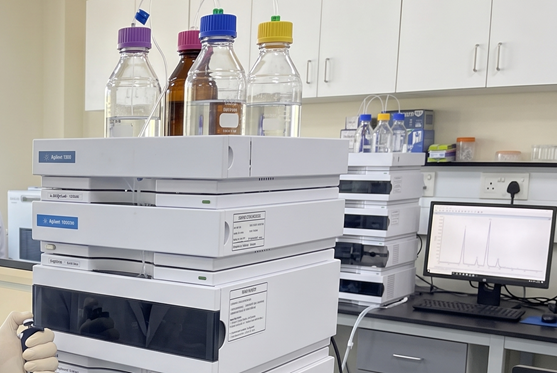
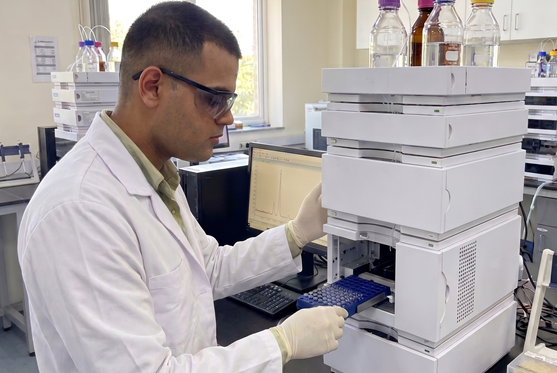
Analysis of amino acids is performed with HPLC UV & Fluorescence detector and FPLC/LPLC System by using classical ion-exchange liquid chromatography with post-column Ninhydrin derivatization and photometric detection.
- Ion-Exchange
Chromatography with Post-Column Derivatization
- Reversed-Phase HPLC
- Gas
Chromatography–Mass Spectrometry
Total amino acids in a sample,
including those attached to protein structures and peptide backbones, are
quantified by total amino acid analysis. This needs to be chemically
hydrolysed first.
Unbound, monomeric amino acids that are naturally
present in physiological fluids, cell culture medium, or extracts are
measured by free amino acid profiling, which simply requires
deproteinization and filtering without harsh hydrolysis.