
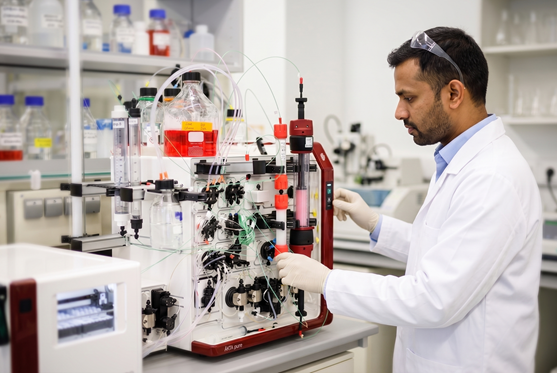
Fast Protein Liquid Chromatography (FPLC) is a form of liquid chromatography optimized for purifying proteins under gentle, low-pressure conditions that preserve biological activity. It is a cornerstone technique in biotech production and protein research, used to isolate a target protein from a complex mixture with high purity, high yield, and minimal loss of structure or function.
What Is FPLC?
FPLC systems use pressurized flow and precise control over buffers, flow rate, and detection to separate proteins based on differences in physical or chemical properties — size (size-exclusion), charge (ion-exchange), hydrophobicity (hydrophobic interaction), or specific binding affinity (affinity chromatography). Because these modes can be combined in a single automated workflow, FPLC has become the go-to system for multi-step protein purification, from a research bench prep through to biotech production scale-up.
Why It Matters in Research
Preserves Protein Structure and Activity
Lower operating pressure and biologically inert flow-path components minimize shear stress and denaturation — critical for enzymes, antibodies, and other proteins whose function depends on precise folding.
High Resolution and Reproducibility
Fine, uniform resin particles allow sharp separation between closely related proteins, supporting reproducible results for structural biology and functional assays.
Scalability from Bench to Production
The same underlying chemistry scales from small research batches to preparative and pilot-scale downstream processing for vaccines, monoclonal antibodies, and other biologics.
Automation and Real-Time Monitoring
In-line UV absorbance, conductivity, and pH tracking let operators make purification decisions on the fly — critical when working with sensitive or unstable proteins.
Compatibility with Multiple Purification Modes
A single FPLC system can be reconfigured for ion-exchange, size-exclusion, affinity, or hydrophobic interaction chromatography without switching platforms.
A Typical FPLC Workflow
- Clarify the starting sample by centrifugation or filtration
- Load the sample onto a pre-equilibrated column
- Run a gradient or step elution while monitoring the UV trace
- Collect fractions and confirm purity by SDS-PAGE or activity assay
- Concentrate and buffer-exchange the final purified protein
FPLC vs. HPLC
| Feature | FPLC | HPLC |
|---|---|---|
| Operating Pressure | Low (biocompatible, gentle) | High (up to 400+ bar) |
| Primary Use | Proteins, peptides, nucleic acids | Small molecules, drugs, metabolites |
| Fluid Path Material | Biocompatible plastics | Often stainless steel |
| Sample Sensitivity | Gentle, preserves bioactivity | Can be harsh on labile biomolecules |
Where FPLC Fits into Biotech R&D
- Antibody and recombinant protein purification for structural and functional studies
- Downstream processing for vaccines and monoclonal antibody manufacturing
- Enzyme purification for kinetic and mechanistic studies
- Structural biology sample prep for crystallography and cryo-EM
- Quality control and polishing steps in biologics production
Best Practices for FPLC-Based Purification
- Choose the right chromatography mode (or combination) based on your protein's biochemical properties
- Optimize buffer composition to maintain protein solubility and stability
- Use a stepwise strategy — affinity capture, then ion-exchange polishing, then size-exclusion for final cleanup
- Calibrate UV and conductivity detectors regularly for accurate peak interpretation
- Validate purity with orthogonal methods like SDS-PAGE or mass spectrometry
Frequently Asked Questions
Is FPLC the same as HPLC?
No. Both use liquid chromatography principles, but FPLC operates at lower pressures with biocompatible materials to protect protein structure, while HPLC is built for high-resolution separation of small, chemically stable molecules.
What types of chromatography can be run on an FPLC system?
FPLC systems commonly support ion-exchange, size-exclusion, affinity, and hydrophobic interaction chromatography, often combined in a single purification workflow.
Why is FPLC preferred for protein research over manual purification?
FPLC offers automation, reproducibility, real-time monitoring, and gentler handling, resulting in higher purity and better preservation of biological activity compared to manual gravity-flow methods.
Can FPLC be scaled up for production?
Yes — FPLC chemistry scales from small analytical runs to preparative and pilot-scale purification, making it valuable across the full research-to-manufacturing pipeline.
Conclusion
FPLC purified protein feeds directly into downstream applications — crystallography, binding assays, vaccine formulation, and quality control testing all depend on having a clean, well-characterized sample. At Allele Life Sciences, our FPLC-based protein purification workflows are built around exactly this kind of multi-step, quality-controlled process, from initial capture through polishing and final QC.