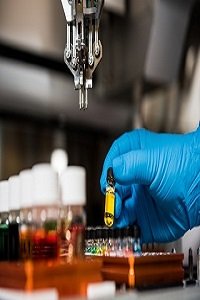
Analytical testing ensures the safety, purity, and potency of pharmaceuticals, food, environmental samples, and bioproducts.
Unit 1 - API & Formulation Characterization:
Assay of Active Ingredient, Preservative Content
Determination, Identification biochemical tests, Quantify
active ingredients, verify raw material identity.
Unit 2 - Microbiological Quality Assurance:
Determine antibiotic potency, Microbial Limit Test (MLT),
Antibiotic Assay (Microbiological Assay), Sterility Testing.
Unit 3 - Pharmaceutical Product & Vitamin Analysis:
Assay & Analysis of product, Analysis of Vitamin C,
Estimation of Drug Content in Pharmaceuticals.
Unit 4 - High-Performance Liquid Chromatography (HPLC):
Principle of HPLC, Parts, Detectors and Application,
Standard Preparation, sample run and data analysis.
Unit 5 - Gas Chromatography (GC): Principle
of Gas Chromatography, Parts, Detectors and Application,
Standard Preparation, Sample run and data analysis.
| Unit | Details | Technologies / Instrumentation |
|---|---|---|
| 1 | Formulation Characterization | Pipetting, Preparation & pH, Biosafety & Waste Disposal |
| 2 | Microbiological Quality Assurance | Microbial Analysis, Sterilization & Safety |
| 3 | Pharmaceutical Product Analysis | Titration and Spectrophotometry |
| 4 | Analysis by HPLC | HPLC with PDA and FLD Detector |
| 5 | Gas Chromatography Analysis | Agilent Gas Chromatography System and Software |
Combination of chromatography (HPLC and GC) and microbiology forms the foundational infrastructure for product safety, regulatory compliance, and quality assurance of cosmetics, food, pharma and many industries.
Pharmaceutical QC teams need analysts skilled in assay validation, microbial limit testing, and chromatographic analysis. This training builds exactly those competencies, positioning you for QC/QA roles in pharma and analytical testing labs.
You'll gain hands-on experience with HPLC and GC systems for compound analysis, along with microbiological assay techniques for sterility and antibiotic potency testing.
Duration: 80 Hrs or Up to 45 Days
Service Charges: We charge fee to cover the expenses of chemical and reagents that is INR 12,000 /- (Indian Nationals) & $200 (Foreign Nationals)
Note: The program utilizes advanced instrumentation, specialized chromatographic resins, and high-grade analytical reagents. Because the fee directly covers these extensive consumable costs and dedicated instrument, the fee structure is fixed and non-negotiable.
Download Training Brochure: